Basement crack repair
Basement Crack Repair in Charleston, WV
Not every basement crack is the same. We figure out why it cracked, then repair it with epoxy injection, carbon fiber reinforcement, or both.
- Led by Joe Saunders, PE
- Free inspections
- Kanawha, Putnam & nearby counties
Reading the crack
The shape of a crack says a lot about what caused it. Thin vertical cracks in poured concrete are often from shrinkage as the concrete cured. Diagonal cracks that are wider at one end can point to settlement. Horizontal cracks, and stair-step cracks running through the mortar joints of a block wall, usually mean soil is pushing the wall inward.
Before we repair anything, we look at the crack’s pattern, width, and whether the wall around it has moved.
Epoxy injection for poured concrete walls
For cracks in poured walls, we inject epoxy into the crack from the inside. The epoxy fills the crack through the thickness of the wall and bonds the concrete back together. It’s a targeted repair that doesn’t involve digging outside.
- Surface is cleaned and injection ports are set along the crack
- The face of the crack is sealed so material stays in the wall
- Epoxy is injected until the crack is filled
- Ports are removed and the surface is finished
When a crack needs more than filling
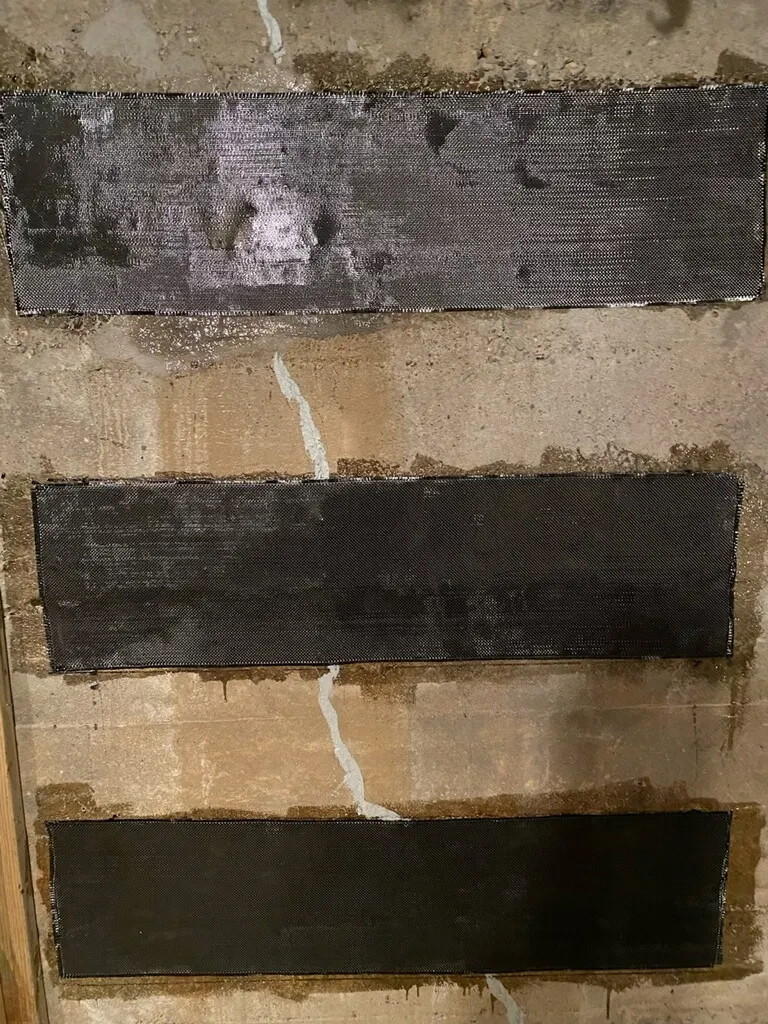
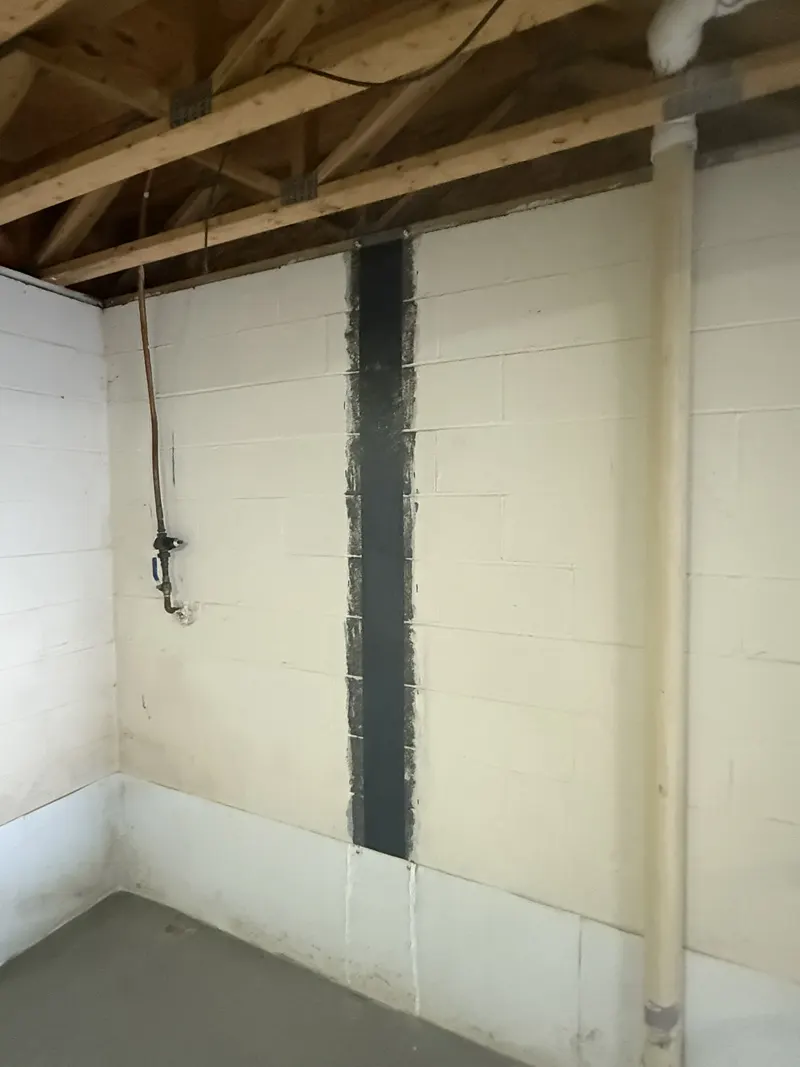
If a wall is bowing or the crack is from soil pressure, filling it isn’t enough on its own. In those cases we reinforce the wall with carbon fiber straps or strips bonded across or along the wall, so it can resist the pressure that cracked it. The photo here shows carbon fiber strips bonded across a crack in a poured wall.
Keeping an eye on a crack
If a crack doesn’t need repair yet, monitoring it is the smart move. Mark both ends of the crack with a pencil and the date, and take a photo with a ruler or coin for scale. Check it every few months and after heavy rain or a hard freeze. If it grows longer or wider, starts to leak, or the wall next to it begins to lean, call us for another look.
Why Kanawha Valley basements crack
Clay soils that swell when wet, hillside lots that send water toward the house, and decades-old block foundations all add up. Many homes in Charleston, Cross Lanes, and St. Albans were built with block basements that crack along mortar joints as the soil pushes on them. Gutters and downspouts that dump water at the foundation make it worse, so we also look at where your water goes.
Related services
Other ways we can help
Questions
Frequently asked questions
Do small basement cracks need repair?
Not always. Hairline shrinkage cracks that aren’t moving or leaking often just need to be watched. Cracks that are wide, growing, leaking, or horizontal should be checked.
Is the repair done from inside?
Yes. Epoxy injection and carbon fiber reinforcement are both done from inside the basement.
Will the crack come back?
That depends on the cause. That’s why we look at soil pressure and drainage, not just the crack, before recommending a repair.
Got a big, scary quote? Get a free second opinion.
An honest engineering review led by Joe Saunders, PE, at no charge and with no obligation.
Request a free inspection
Tell us what you’re seeing and we’ll follow up to set up a visit. Photos of the cracks or problem areas help.
- Free inspection and second opinion
- Led by Joe Saunders, PE
- No pressure, no obligation
Prefer to talk? Call or text 304-767-8623 or email info@mcawva.com.